
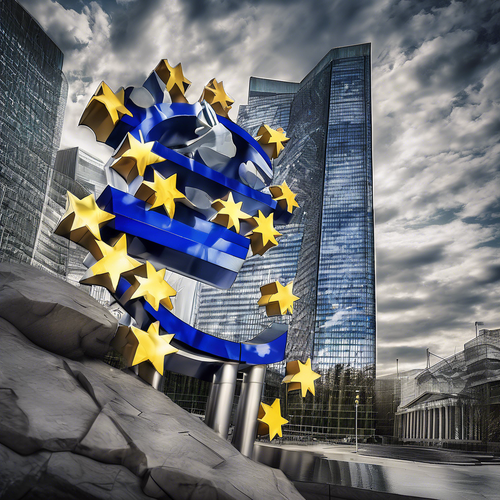
E.C.B. Pauses Rate-Cutting Campaign Amid Trade Disputes 📉🌍
In an unexpected twist, the European Central Bank (E.C.B.) has decided to hit the brakes on its ongoing rate-cutting campaign. As the specter of trade disputes looms large over the horizon, questions about the stability of the Eurozone’s economy become ever more pressing. While one may imagine a world where central banks have the omnipotent ability to shape economic destinies, the E.C.B.’s latest decision reveals a reality riddled with uncertainties and contradictions.
A Delicate Balancing Act
Ironically, the very tools designed to foster economic stability—a series of interest rate cuts—may now be viewed as double-edged swords. By lowering interest rates, the E.C.B. aimed to lighten the burden on borrowers, hoping to stimulate consumption and investment. However, with inflation rates flickering like a malfunctioning light bulb, rising trade tensions present a formidable challenge to this well-intentioned strategy.
Trade disputes, particularly those involving major economic powers like the United States and China, create an unpredictable backdrop against which monetary policy unfolds. As tariffs rise and supply chains become strained, the subsequent ripple effects filter through the European economy, raising alarms in Frankfurt. It’s as if central bankers find themselves juggling glass balls in a circus act where each ball represents a fragile economic variable. One wrong move, and the entire performance could come crashing down.
The Economic Landscape: A Contradiction in Terms
Consider the contradictory nature of recent economic reports. Unemployment rates have dipped, giving the impression that the Eurozone is on the road to recovery. Yet inflation persists as a bothersome guest who refuses to leave the party. Surging energy costs and supply chain disruptions make it difficult for average citizens to feel the benefits of declining unemployment. The E.C.B.’s decision to pause reflects this dissonance, as if the institution is simultaneously preparing for a celebration while aware that the confetti might still be covered in dust from last year’s economic turmoil.
The Stakes of Trade Disputes
Trade disputes add layers of complexity to this economic narrative, serving as a thundercloud hanging ominously over the E.C.B.’s carefully laid plans. Economists warn about the potential fallout from tariffs and sanctions, creating deep potholes in cherished trade routes. The Eurozone, with its intricate web of economic interdependencies, now grapples with the uncertainty of whether trade barriers will shield or suffocate its economies.
- Increased Costs: Tariffs can turn everyday goods into luxury items overnight, affecting household budgets.
- Supply Chain Disruptions: The reliance on global manufacturing makes the Eurozone particularly vulnerable to international tensions.
- Investment Hesitance: Businesses are likely to delay capital expenditures in an uncertain trade environment, stifling growth.
Is it any wonder that the E.C.B. finds itself in a proverbial pickle? On one hand, they seek to perform economic CPR through lower interest rates; on the other, they must navigate the uncharted waters of geopolitical tension. Such is the reality of modern monetary policy—less a science and more an exercise in advanced risk management.
The Path Forward: Navigating Through Turbulence
So, what lies ahead for the Eurozone as the E.C.B. walks this tightrope? The decision to pause rate cuts is not a rejection of the policy’s potential efficacy; rather, it is a cautious acknowledgment of external pressures. It sends a clear message: in times of tribulation, prudence may sometimes be the best course of action.
Market analysts are left to ponder: will trade tensions settle into a lull, allowing the E.C.B. to resume its rate-cutting journey? Or will they escalate, forcing the bank to reevaluate its very mandate? As uncertainty settles like a fog over the economic landscape, one thing remains clear: the E.C.B.’s ability to adapt to shifting circumstances is more crucial than ever. Like a seasoned sailor reading the wind, the bank must chart a course through unpredictable waters with both caution and audacity.
The Human Element
At its core, this economic saga is not merely about numbers or rates. It’s about individuals and families who feel the weight of these decisions every day. Consider the young couple hoping to buy their first home, anxiously watching mortgage rates fluctuate. Or the elderly citizen on a fixed income, calculating whether she can afford the rising utility bills as energy costs climb. In the abstract world of monetary policy, it’s easy to forget that behind every statistic lies a story, a hope, a dream.
As the E.C.B. takes stock of its strategy amid mounting trade disputes, it must remember this essential truth: monetary policy is ultimately about real lives and tangible impacts. The pause on rate cuts may be described in academic terms, but it’s the human stories that give life to those decisions—an irony that can’t be overlooked in the pursuit of economic stability.
In the grand tapestry of the Eurozone’s economic future, the threads of policy decisions, trade disputes, and human aspirations are tightly interwoven. As the E.C.B. contemplates its next moves, the stakes have never been higher. Will it cling to traditional levers or innovate in this new age of unpredictability? Only time will tell, but one thing is certain: the journey ahead is fraught with both peril and possibility. 🔍💼