
Far-Right Israeli Minister Calls for West Bank Annexation: A Controversial Step Backwards 🚨🇮🇱
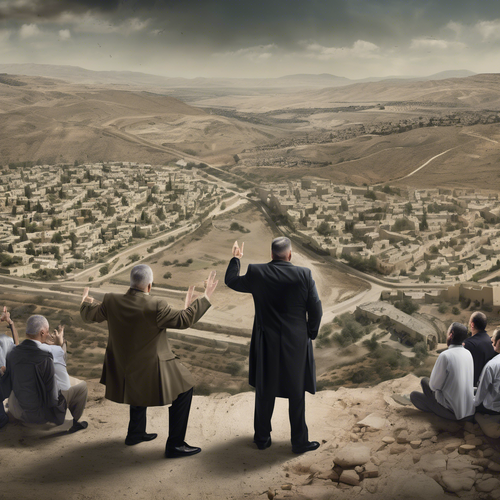
As the sun sets over the ancient hills of the West Bank, casting long shadows across the landscape, a call echoes from the heart of Israeli politics—a far-right minister has urged the government to formally annex this disputed territory. Here, in this tumultuous arena of competing narratives and historical grievances, one must wonder: are we witnessing a bold new chapter or a destructive plunge into the past? 🕰️
The announcement came amidst a backdrop of rising tensions and burgeoning nationalist sentiments, as if the very earth beneath the feet of Israelis and Palestinians alike was shifting with the tectonic pressure of unresolved conflicts. To many, this call for annexation is a rhetorical flourish designed to rouse a particular voter base, one that thrives on the idea of restored glory and historical claims. Yet, amid the fervor, the human stories—the pain, hope, and desire for peace—are often drowned in the clamor of political ambition.
The Irony of Historical Paradox
History, it seems, is a relentless teacher. The very notion of annexation invokes not only the might of military sovereignty but also the scars of previous conflicts—wars fought, lives lost, and the trauma etched into the psyche of entire nations. Ironically, this minister’s call comes at a time of purported peace negotiations and international scrutiny, a contradiction as stark as light against darkness. The push for sovereignty mirrors the aspirations of Palestinians for their own statehood, a desire that remains tantalizingly out of reach, much like a mirage shimmering over an arid desert.
To annex, one must ask, what legacy is being forged? Is it one that unifies or divides? In echoing the cries for land that hold centuries of pain and identity, the minister raises a question deeper than mere borders: can the soil of conflict cultivate peace? 🌱
The Human Cost of Political Ambition
Behind the political machinations, real lives hang in the balance like threads in a tapestry—intricate and complex. For families enduring the strife of occupation, each announcement can feel like a fresh wound, as tangible as the stones thrown against walls. The children who play amid rubble, forged in the fires of conflict, grow up in a world dictated by adult decisions made in far-off offices, the consequences of which rain down heavily upon their shoulders. What sense of future can they hold on to when territorial lines are drawn with the stroke of a pen, rather than the gentle hand of understanding?
One might liken the situation to a game of chess—each move strategic, calculated, and laden with the risk of enflaming the next, yet those manipulated on the board can only sit, watch, and prepare for the inevitable fallout. Does a checkmate on one side lead to liberation for another, or does it ensnare both in a cycle of perpetual conflict? ♟️
International Responses: A Tapestry of Dissent
The international community watches closely, often reacting as if in a theater performance—the world leaders, tension palpable in the audience, poised to respond. Many see annexation as a grievous escalation, akin to tossing a lit match into a powder keg. Nations have denounced the proposal, reminding Israel that its perceived sovereignty is intertwined with the right to exist for the Palestinian people. They caution that any unilateral move risks further alienating a nation already feeling the weight of isolation. The words may resonate, yet they often seem to disappear into the echo chamber of political discourse, unheard and unheeded.
Strikingly, the irony is palpable when one considers that the very rhetoric of peace—of coexistence, mutual respect, and shared humanity—gets buried beneath layers of political theater. The world watches not just for the actors on the stage but for the silent audience who bear the scars of this long-fought play. 🎭
Conclusion: What Lies Ahead?
As this potential annexation looms large, the human stories entwined with the land call out for recognition, echoing through the valleys and hills of the West Bank. Will Israel move boldly into an uncertain future, fueled by nostalgia and conviction, or will it choose the murmur of quiet reflection—of peace that does not come at the expense of another’s dreams?
The fate of the West Bank is not just a political matter; it is a profound human issue, where history, identity, and aspirations converge. Perhaps, at this crossroads, the most audacious act of all would be to embrace the dualities—to acknowledge the depths of history while reaching forward to forge a path of peace, healing, and coexistence. For in the end, walls built on paradoxes and ironies might fail to sustain the weight of shared hopes for a better tomorrow. 🌍