
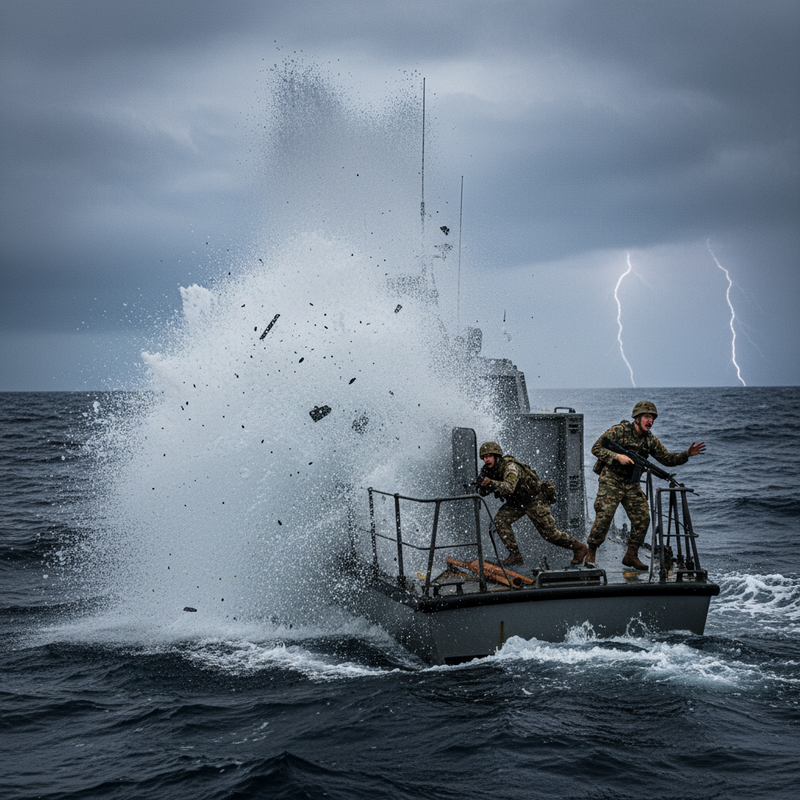
What the Pentagon’s Attack Videos Reveal About the Boat Strikes at Sea ⛴️🎥
We live in an era where wars are often neater when viewed from afar—drones hum like mechanical bees, missiles trace trails of light across the sky, and the ghosts of conflict are distilled into downlinked pixels and bytes. Yet, when the Pentagon releases videos of maritime boat strikes, the slick, surgical image of modern warfare cracks like a ship’s hull against a stormy sea, revealing raw, unsettling human stories lurking beneath.
The Cold Lens of the Camera: What Are We Really Seeing?
The Pentagon’s videos—shimmering, high-definition snapshots of force in motion—unveil an ironic twist. They claim transparency, yet the footage dances on the line between evidence and spectacle. Much like a magician’s flourish, where the eye follows the wand and misses the sleight of hand, these videos capture the exact moment a missile rends the water or a boat erupts in flame, but they do not always reveal why, or at what cost.
Ironically, these clips are at once censored and sensational, framed to reassure the public of precision and necessity while obscuring the chaos, confusion, and collateral damage where the sea’s horizon turns crimson. The contrast is striking: clinical technology meets unpredictable human drama, a duality as sharp as the jagged cliffs against a placid ocean.
Striking Antithesis: Machine Efficiency versus Maritime Chaos
Consider the juxtaposition: an unmanned drone hovers silently, calculating trajectories with algorithmic coldness, while below, on the waves, frail boats often barely tangible as human habitats—some fishing craft, some hastily armed vessels—become targets in a deadly chess game. The elegance of technology collides with the unpredictable fluidity of the sea, a battlefield where control is as illusory as mirage.
The Pentagon’s videos depict missiles traveling with the precision of a surgeon’s scalpel, yet the sea strikes resemble tempestuous brushing strokes on a volatile canvas. Waves swallow debris, while survivors—sometimes mere specks on the water—contend with a fate undecided by digital clarity. It’s a paradox where high-tech warfare exists alongside age-old human vulnerability.
Behind the Footage: Human Stories Beneath Explosions
Watching these videos, one might be forgiven for thinking the boat strikes are neat and instantaneous—an almost poetic eradication in the theater of war. But each flash and plume conceals layers of lived experience: crews caught between survival and combat, civilians inadvertently ensnared, and the watery graveyards where stories end abruptly.
This complexity recalls the way nature deals with storms: sudden, overwhelming strikes that leave behind quiet devastation masked by tides and time. Like a hurricane’s eye, the videos capture the violent heart, but rarely the aftermath, where the human cost lingers like salt residue on skin.
The Strategic Lens: Why These Strikes Matter
From a military perspective, boat strikes serve purposes far beyond the visual spectacle. They are tactical maneuvers aimed at disrupting smugglers, denying hostile forces maritime control, and projecting dominance in contested waters. The videos are both proof and propaganda—assertions of capability broadcast to friend and foe alike.
In a realm governed by international laws and shifting alliances, public release of such footage is a double-edged sword. It can build empathy or fuel outrage; it can clarify intent or deepen mystery. Are these videos evidence of restraint or a rehearsal of ruthlessness? The answer always depends on whose eye watches the play unfold.
When Transparency Turns Tactical
Yet, the Pentagon’s selective transparency carries a subtle irony. While intended to demonstrate accountability, it also constructs narratives. The “attack video” becomes a vignette — paused and trimmed like a highlight reel — less a raw eyewitness report and more a curated message shaped to soothe or stoke public perception.
The real story, often omitted, is murky: the fog surrounding rules of engagement on unpredictable seas, the ethical quandaries of targeting vessels that might harbor innocents, and the spectral presence of unknown casualties swallowed by both media silence and ocean depths.
Why We Should Look Deeper Than the Pixels
We might ask ourselves: do these videos offer clarity, or are they reminders of how much remains veiled in the fog of naval conflict? Like watching sunlight fracture through turbulent water, the images dazzle but distort. What appears as decisive might be desperate; what looks like clean strikes might be messy reckonings.
In this light, the attack videos serve as a Rorschach test for modern warfare—revealing as much about contemporary military doctrine and media framing as about the actual moments of violence they encode. They urge us to consider the paradox that in an age of seemingly omniscient surveillance, truth at sea is as elusive as the shifting tides.
Ultimately, the boat strikes underscore a sobering truth: war, even when mediated by drones and missiles, remains an intimate human tragedy. The raw roar of explosions is not just a demonstration of force but an echo of fragile lives thrown into the churning crucible of conflict.