
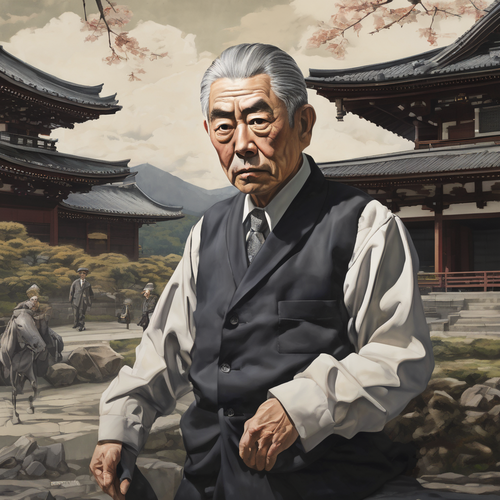
Tomiichi Murayama: The Leader Who Dared to Apologize for War 🕊️🇯🇵
Tomiichi Murayama, a figure whose life spanned a century marked by profound contradictions, passed away recently at the age of 101, leaving behind a legacy as complex as Japan’s own post-war identity. Known for his groundbreaking apology for Japan’s wartime aggression, Murayama’s tenure as Prime Minister from 1994 to 1996 signified a delicate balance between historical remorse and national pride, a tightrope walk reminiscent of the intricate origami for which Japan is renowned. 📜
A Life Shaped by History
Murayama was born on March 3, 1924, in a Japan recovering from the scars of war but not yet fully understanding the gravity of its past. Growing up amidst the upheaval of World War II, he witnessed firsthand the devastation wrought by militarism. Ironically, the very country that once embraced militaristic glory would find itself in the throes of self-examination under his leadership—much like a poet looking in a cracked mirror, trying to reconcile beauty with its marred reflection. 🔍
As Prime Minister, Murayama recognized an unsettling truth: the act of apologizing could be more powerful than asserting dominance. His 1995 apology, acknowledging the suffering caused by Japanese aggression during the war, turned heads and ignited debates. Some hailed it as a courageous step toward reconciliation, while others questioned why patriotism seemed to falter in the face of historical accountability. The irony is stark; a nation known for its resilience found strength in vulnerability, demonstrating that progress often requires a willingness to confront uncomfortable truths. ⚖️
The Apology That Shook a Nation
Murayama’s apology was not merely a political maneuver; it was a profound moment of reckoning that contrasted sharply against the nationalist fervor that often colored Japanese discourse. His proclamation, “I would like to express my sincere apologies and remorse,” echoed like a reverberation of thunder in a clear sky, launching waves of criticism and praise alike. Yet, it also underscored a crucial paradox: that accepting the past can foster a more robust national identity, while denial merely preserves a brittle façade. 🌩️
In a nation like Japan, where history is often a needle that threads the fabric of national identity, Murayama emerged as both a thread and a needle. He embodied the complexity of Japanese society—bridging the gap between remembrance and forgetting, between guilt and responsibility. The contrast between his approach and those of his predecessors points to an intriguing irony: to love one’s country does not mean to ignore its blemishes. ❤️
Legacy Beyond Borders
Murayama’s legacy transcends the geographical confines of Japan, resonating with leaders around the world who grapple with their own countries’ fraught histories. Is it not a daunting task for any leader to incite reflection while managing the visceral emotions of their constituents? His humility and grace set a tone for international relations, teaching that sometimes strength lies in softening one’s stance. As Murayama himself once stated, “A real leader has the courage to face their own nation’s history.” 🌎
Yet, the question lingers—can his example be a model for leaders today? In a world increasingly polarized, Murayama’s life presents an evocative simile: like a solitary cherry blossom blooming against a backdrop of thick clouds, his vision for a reconciled future remains a fleeting but beautiful aspiration that illuminates the path forward. 🌸
The Future of Apology
In reflecting upon Murayama’s life, we find a multifaceted truth: apologies may not change the past, but they can forge pathways to understanding and healing. Leaders globally can draw lessons from his poignant example, recognizing that acknowledging historical pain is an essential step toward collective growth. The tension between tradition and modernization posits a striking antithesis, highlighting how, in a globalized world, the moral weight of history must be shouldered by all nations. 🛤️
As we bid farewell to Tomiichi Murayama, we must ask ourselves: does true leadership lie in the pursuit of perfection, or in the willingness to embrace one’s imperfections? Murayama’s legacy reminds us that history is not merely a timeline but a living, breathing narrative—one that requires courage, humility, and, above all, a willingness to apologize. With the passing of this remarkable leader, we are left with a responsibility: to carry forward the lessons of truth, reconciliation, and the art of apology—a journey that sparkles like stars in the night sky, urging the world to shine brighter despite its shadows. ✨