
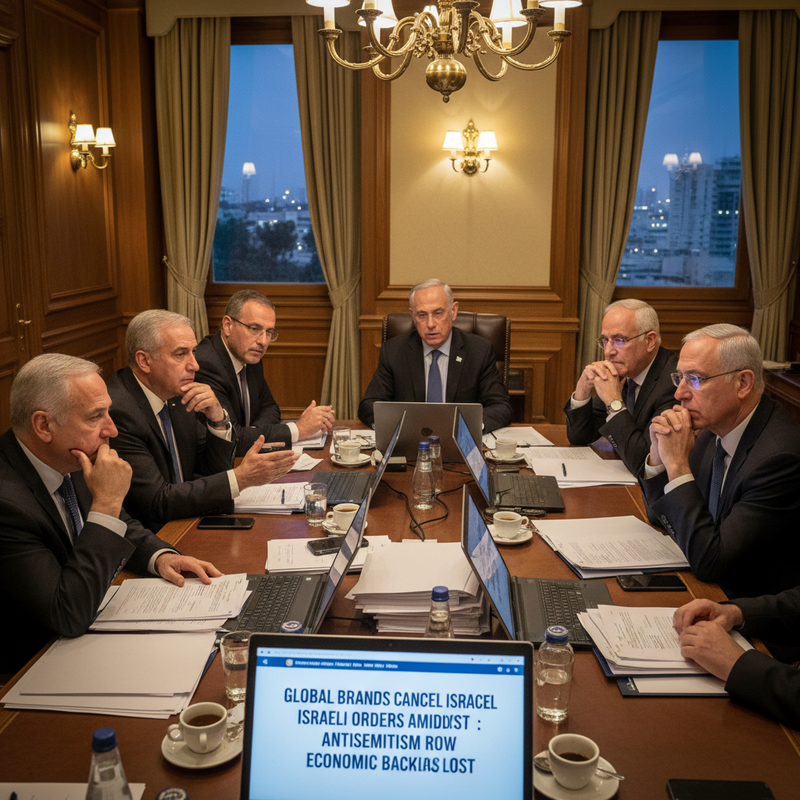
Israeli Government Accuses Mamdani of Antisemitism Over Canceled Orders ⚖️🕊️
In a theatre where diplomacy often resembles a tightrope stretched above a chasm of historical wounds, the latest act involving the Israeli government and Mamdani—a figure caught in the crossfire of commerce and accusation—unfolds with all the subtlety of a stone disrupting still waters. The government has publicly accused Mamdani of antisemitism following the cancellation of several orders, a move that has sent ripples through political corridors and public discourse alike. But beneath the surface-level grievances lurk questions more labyrinthine than they first appear: Can a business decision transform overnight into a politically charged indictment? And how often do rhetoric and reality dance a deadly tango in the world of international trade?
The accusation, delivered with all the gravity reserved for historical demons, arrives at a moment when commerce and identity intertwine like ivy strangling a fading wall. Mamdani, a businessman whose dealings span continents, repositioned his orders amid mounting political pressures, yet the Israeli government opted to construe this recalibration as an act infused with antisemitic intent. The irony is so sharp it cuts like a razor—while accusing Mamdani of hatred, the government simultaneously exposes how business transactions can become battlefield posts in a war of narratives.
The Anatomy of an Accusation
To unpack the layers demands peeling away the immediate headlines like an onion, revealing the complexity of motives and misgivings underneath. Mamdani’s canceled orders, ostensibly commercial decisions influenced by fluctuating geopolitical winds, were seized upon as symbolic blows by Israeli officials. But what is striking is the antithesis between Mamdani’s image as a merchant and the government’s portrayal of him as a harbinger of hostility.
This contrast is like stepping from a modern, glass skyscraper into a medieval courtyard—two worlds colliding, not merely chronologically but ideologically. Where Mamdani sees shrewd business strategy or ethical lines, the Israeli rhetoric paints a caricature of malevolence, transforming commerce into conflict, contracts into cultural clashes.
“The swift leap from canceled orders to antisemitism exemplifies how accusations can sometimes become a fog screen, obscuring more than they reveal,” remarked Dr. Ayelet Friedman, a Middle East affairs analyst. It is a dramatic reminder that words, like stones thrown into a pond, can create unpredictable and far-reaching ripples beyond their original splash.
Orders Canceled, Relationships Severed — Or Merely Rebalanced?
One cannot help but wander briefly onto a tangent about the curious nature of human commerce. Much like the unpredictable shifting of tectonic plates beneath an otherwise serene oceanic surface, business decisions often mask undercurrents of political tension, social anxiety, and cultural misunderstandings. Mamdani’s canceled orders feel less like isolated events and more like cracks appearing on an ancient mosaic—fractures where the tensions of history, identity, and economics converge.
Yet, the striking antithesis between economic pragmatism and ideological rigidity here is mesmerizing. Is Mamdani’s decision a cold calculus, or a nuanced protest? Conversely, is the government’s accusation an earnest defense or an overreach, a political strategy wrapped in the cloak of moral indignation?
- Political symbolism: The cancellation is viewed less as a business maneuver and more as a political signal.
- Cultural sensitivity: Any perceived slight or withdrawal is magnified as an attack on identity.
- Economic consequences: Beyond rhetoric, the severed ties threaten practical cooperation and livelihood.
- Media amplification: News cycles often conflate motives, amplifying tensions.
The Irony of Accusing for Exclusion
The accusation’s irony lies in its double-edged blade: while intending to deter acts deemed hostile, it risks alienating potential bridges. Mamdani, whether vilified or misunderstood, sits now as a symbol both of commerce and dissent—his canceled orders echoing like a distant thunderclap across diplomatic fields too brittle to absorb surprises. It’s as if calling out antisemitism in this context becomes a cloak shielding the discomfort of economic entanglements that are, in truth, laden with mutual dependencies.
In the grander sweep, this moment reflects a paradox as pungent as the contrast between the desert’s arid stillness and the sudden bloom after rain. The Israeli government’s stance, in its sternness, nudges the boundaries of political discourse, while Mamdani’s choices might just be pragmatic ripples caught in the tidal waves of identity politics.
One is reminded of a fable where the accused and accuser both stand in the shadows cast by history—and in such shadows, truth is often the first casualty. The question, then, is whether illumination will come from deeper conversation or louder accusation. 💭
What Does This Mean Going Forward?
From the microcosm of Mamdani’s canceled orders radiates a macrocosm of broader themes—trade disputes morphing into ideological battles, economic actors entrapped in geopolitical narratives, and the constant tension between dialogue and discord. Will this episode mark a rupture or a catalyst for clearer communication? Will accusations further blur lines or prompt fresh self-examination?
History teaches us that controversies such as these are seldom about single actions, but rather about the echoes those actions awaken in collective memory. Mamdani and the Israeli government find themselves caught in a narrative dense with symbolism, where commerce becomes a cipher for identity and accusation a stand-in for historic grievances.
Perhaps, in this swirling swirl of commerce and accusation, the real challenge is embracing the discomfort of ambiguity rather than rushing to judgment—learning that not every canceled order is a sign of hatred, nor every accusation a beacon of truth. After all, in politics and business alike, the sharpest blades are those of nuance and restraint. 🔍