Trump’s Health Report Shocks Absolutely No One 🍏🤔
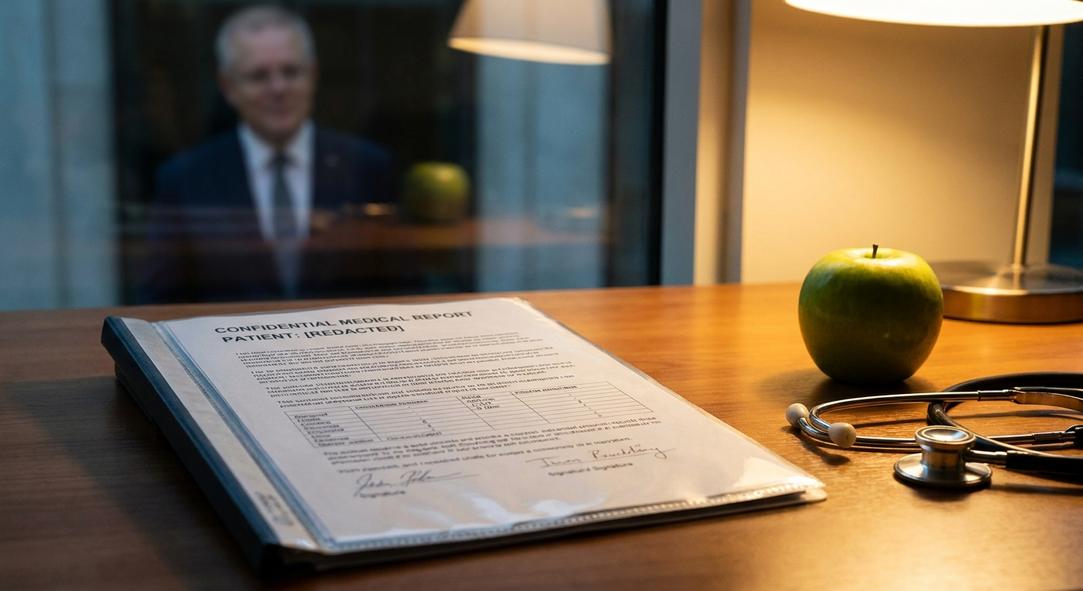
If there’s one thing that unites us all, besides our shared love for a good reality TV segment, it seems to be our ongoing fascination with the state of a leader’s health. President Trump, whose doctor recently pronounced him in ‘excellent health’ after yet another routine check, once again finds himself the subject of public scrutiny 🩺. But really, isn’t every report card of perfect health just a slightly too shiny apple on the desk of global skepticism?
Prescription of Perfection or Just Another Routine?
The report, delivered from the White House, ostensibly paints an image of vigor—and yet, one can’t help but reflect on how the exuberant proclamation sounds almost too well-rehearsed, like a politician’s promise before an election 📈. Ironically, this is not the first and certainly won’t be the last time a president enjoys such flattering assessments. History is rife with examples where reports swing as fully and freely as a pendulum caught between truth and diplomacy.
The very nature of these medical assessments raises eyebrows: Is it a declaration of invincibility, or a strategic card tucked safely out of the public eye, released only when the show must go on? These narratives unfold with the reliability of a well-oiled machine, their predictability rivaling that of a sunrise—consistent, yet cloaked in the occasional temporal surprise 🌅.
An Irony Wrapped in an Enigma
To say that the nation’s leader is in “excellent health” is almost akin to describing a political debate as a “lively conversation”—both understate a complexity that is best observed in the silent exchange of glances rather than direct dialogue 😎. Of course, no one is expecting detailed medical charts splashed across the evening news, but the dance between transparency and politics is as delicate as a tightrope walk in high winds.
The public reaction runs parallel to the report, merging skepticism with a curious anticipation. As if attending the finale of a long-running series, the audience waits for the twist that might never come, finding comfort in critiquing the narrative—or lack thereof. In hindsight, presidential health reports might feel like the proverbial tree in the forest: does it really make a sound if no one’s around to hear it—or more aptly, believe it?
Stark Contrasts in Public Perception
The curious consensus draws from broader cultural and political divides. Comparisons with past presidencies bring about reflections on how health scrutiny has warped over centuries, and through these lenses, the report almost feels like a statement against the modern manifesto of transparency. Today’s public, wielding digital pitchforks, demands insights deeper than the gloss of “excellent health,” yearning perhaps more for confirmation of their own preconceived notions than for new information 🌌🔍.
Yet, in the backdrop of these healthy declarations, history whispers tales of presidents who, despite impeccable reports, faced their own unforeseen battles, political and personal alike. Roosevelt, Kennedy, Wilson—in each era, contrasts emerged as stark reminders that human resilience often sails unseen beneath political posturing. Herein lies the remarkable power of a public statement to be both steeped in tradition and subverted by context.
And thus, as we ponder over President Trump’s latest clean bill of health, alongside freshly brewed coffee and Sunday papers, it becomes clear that these announcements serve as much to assure the public as they do to preserve an image. Ultimately, the question remains: in what do we place our trust—the words of a doctor’s report, the glimmer of political intent, or the stark contradictions of history that remind us, ever so gently, to question everything 🕵️♂️?